Tuesday, 27 November 2012

Evaluation of political protest - slut shame and victim blame


 nivenbrechtgenius: slut shame
Today we had our protest for our political theatre assessment. We had planned our piece to take place outside, with us wearing provocative clothing; we had made signs with slogans and rape crime statistics on them. We wrote rude words used to describe women all over our arms and chest.
I think what worked well in our piece for me is that I had done lots of research and I felt very strongly about the issue we were protesting for, and so did some others in my group. This meant during the protest we were naturally driven throughout.

The issues we didn't take into consideration was the weather, we knew that we would be cold, but just not quite how cold. The water we were using to wash ourselves with meant that we got even colder when we were just standing and chanting. This was a good experience despite the discomfort because it will mean we can begin to work in any kind of environment and learn how to work through outside forces such as weather or how you might be feeling and still carry on with your piece.

The choice of costume we made was very important to our protest. If we hadn't dressed the way we did our protest wouldn't have been as successful or as powerful and it would have lost some of the meaning. I think what we overlooked is that not everyone who came to watch our protest would have had a mutual respect for us and our cause. I noticed they were lots of people taking pictures, laughing, pointing and objectifying my group and me. I found this disturbing because of the subject matter we were dealing with. This is a key part of public performance, not everybody will understand where you’re coming from and you won't always get the reaction you were hoping for.

The good part about the site we chose was that it meant that when all the year 10s and 11s came out on their break time we were the first thing they saw as they came out of the main building. This meant we attracted a large audience which is what protests aim to do, to get attention and support for an important issue. We seemed to get a better reaction from the pre 16 students. They seemed to respond to it as we had people joining in with our chants and asking us some questions about the cause. This felt like we were making more of an impact with them.

If we were to do it all over again I would have learnt more than one passage from project unbreakable. This is because we had to do our protest on a loop, so it would have kept it fresher for us if we had more things to tell, and perform. I maybe would have chosen an indoor sight. People seemed to respond well to our chanting and when we had a feedback discussion someone said how they thought this was a good way of getting our message across. I would have thought more about if people make inappropriate comments on our costumes and us as people, what we should do about it. We could have made a plan of things to say back to anyone who did to challenge them and try making them understand our point. As well as this more audience interaction would have been interesting it may have made the people watching like they could ask us questions and try and understand the issue more if they didn't already.

Tuesday, 20 November 2012

Epic Theatre

Epic theatre is the form of theatre in which Brecht created along with other practitioners in his career. However, later on in his career he preferred the term 'dialectical theatre'. This is because he felt epic theatre was too formal and did not describe the form in the best way.

Epic theatre requires the actors to use 'Gestus' in performances. This is the combination of gesture and attitude to express what the character thinks and feels about certain things.  The main aim of Epic theatre was to make the audience aware at all times that they were watching a play. This was different to naturalism where Stanislavsky tried to mimic the everyday in order to immerse the audience, epic theatre was not meant to create escapism for the audience. It was meant to make them question and think about why and how things were happening onstage.

In an epic theatre play there would not be loads of big staging and back drops to try and make it realistic. Often if an actor needed to change costume, they would do so onstage in front of the audience onstage. If props were needed to be moved either the actors could do it or stage management could, but often, like in the national theatres production of 'Mother Courage and her children' by Bertolt Brecht, they would not wear black like in traditional theatre but they wore their own clothes. This meant they would stand out more.

Alienation Effect (Vermfremdungseffekt) translation
This was the technique Brecht wanted to use in epic theatre. It was the way he thought the audience would be able to question what was going on onstage. It was where the audience felt detached from the characters onstage. You can achieve this by creating something strange and out of the everyday. This will mean that the audience find it strange and immediately notice it and begin to question why, because of how peculiar it is. This is like when we did the moody objects exercise.

Lesson Notes - Session 3

This lesson we began to devise and rehearse our final political performance. We are using the play 'The Price' by Lena Kitsopoulou. We have tried to create our piece in a Brechtian style. The Price already incorporates this style in the way that the characters are just called husband, wife and checkout person. We have developed this into having several checkout girls. No character in our piece has a personal first name, we have baby, checkout girl, husband, wife and store manager. Except for the store manager everyone is played by multiple people. This could be showing capitalist values work by having one person with power and lots of people with less status under their control.

We have planned to give out receipts to the audience before they even enter the performance. These will be charging them for things like breathing, brushing through their hair, putting their hand in their pocket and other everyday normal human things. This will make the audience feel uncomfortable and work as a way of alienating them. This is something Brecht felt strongly about. He did not want his audience to sit down and relax and be told a story, he wanted them on edge contstantly asking questions. By having this receipt giving sequence it will begin that process before they even enter our theatrical space.

We have incorporated songs into the play. We have changed the lyrics of the songs 'Price tag' by jessie j, 'bills, bills, bills' by Destiny's child and 'money' by Abba. Using these songs will create something strange onstage which will cause the audience to question it and it will alienate them. When you go to watch a play you don't expect songs in the same way as you do when you go to see a musical. This means it migh suprise the audience. The way we are using the songs, in a supermarket scene, having groups pop up and begin singing in between the lines being spoken by the husband and wife, will create a unrealistic atmosphere within the play. This combined with the concept of the play being that you can just buy a baby in this supermarket might make the audience feel like they are being pulled into a alternative world very different to their own. However, we are going to have people reading out stage directions which will keep the audience reminded that they are still watching a play.

Wednesday, 14 November 2012

Political Protest -

SAY NO TO SLUT SHAMING AND VICTIM BLAMING

God said unto woman: "I will greatly multiply thy sorrow and thy conception; in sorrow thy shall bring forth children; and thy desire shall be to thy husband, and he shall rule over thee." Genesis, Chapter III verse xvi

We were all given the task of devising a theatrical political protest in groups to last about 5/10 minutes. I am in a group with 3 other girls and we decided to do a protest about 'slut shaming and victim blaming'. This is essentially the campaign for rape to be taken more seriously by people and by the police, and that it isn't the victims fault but the rapists. I first had the idea to do something like this because I  went on the official 'slut walk' protest where men and women all got together and protested and made speeches in trafalgar square from rape survivors and other women's rights campaigners.

It is basically against the idea that when a women decides to report a rape, which many don't as it is too traumatic, they are asked about what they were wearing and if they had been drinking. The public demonstrations sparked from when a police officer said that, in order to avoid being raped 'women should avoid dressing like sluts'. 


This is a link explaining some of the issues we are campaigning. The original Slut Walk 2012 was where I took my stimulus for our protest and where I really heard what some survivors had gone through.

Our basic idea for our protest was to dress 'provocatively' and write derogatory words for women and our sexuality such as 'slut' and 'whore'. We then wanted to have signs with official rape crime statistics so we had some factual political grounding in what we were saying. Then we are going to use the words from an organisation called project unbreakable which is where rape survivors wrote down on a banner what their rapist said to them before and after the attack. They were then photographed. 


This is a link to project unbreakable. We decided this was a good stimulus to use for the dramatic side to our protest because it is real, honest and incredibly emotive.  Using this as our verbal communication, we are also going to be using water or face wipes to try and scrub away the words written all over us. This could be as a way of symbolising how hard stigma and reputations can be to get rid of and how rape is a crime that stays with it victims and can take so much away from them, even though it can create the most amazing survivors.

Rape Crime Statistics

  • 30% of people surveyed said that rape was partially or totally the victims fault.
  • In 2004 the conviction rate for rape was 5.3% or 1 in 20 (the lowest on record)
  • Women are more likely to be raped by their husbands or boyfriends or a person they know in some way.
  • False accusation of rape and sexual abuse is no higher than in any other crime.
  • Between 1/2 and 2/3 of reported rape cases do not advance past the investigation stage. 
  • Half of rape convictions were due to a guilty plea ended in Aquital.
  • There is supporting evidence for 86.7% of cases so the majority isn't  one persons word against the other.
  • If you were intoxicated when you were raped you have a lower chance of getting your attacker convicted.

Tuesday, 13 November 2012

Lesson Notes Session 2

Brechtian Characters

We were each given a generic character name and title such as Veronic Vigar - a feminist. We then had to embody that character and move around the space. My character was called lucious Lucie - a barmaid. We then had to come up with a sort of catch phrase to help us get into character. Mine was 'would you like a little lemon wedge with that?'.

Not having anymore information than a name and title meant all our characters were being based on stereotypes. It would mean that our characters were designed to be representing a certain type of person in society as opposed an individual and three dimensional character with their own story.

It was easier to create my character when I allowed myself to push the character when I allowed myself to push the characters energy and let it be an unattractive character. This was difficult when we had to walk around the space alone and show our character to everyone. When I first did it and said my line my teacher said I needed to give more energy to it. I was told to higher my voice in order to make my character even more unappealing.

These kind of characters mean the audience don't spend time trying to work out who a character is and what  they are doing. This means it works off of the stereotypes the audience already have. Using characters like this with these kind of physical interpretations and title names the audience can know who they are straight away. This links to this idea that Brecht had of not needing the audience to emotionally connect with the characters or the story but why and how the story was happening. These characters therefore would help when trying to alienate the audience.


Gestus

This is the combination of gesture and attitude. It is an idea that Brecht used in his work that when you see a character onstage you can only tell their attitudes and opinions about something by how they react, and their reaction can be shown in a gesture.

We tried to understand this theory in lesson today. We were introduced to this idea by having someone in our class come up in front of everyone and march onstage then salute to the front. This told us as an audience immediately that this character onstage was a soldier. This was clear and obvious and we barely had to question it. This linked back to the work we did on making the physicality's of a character  obvious for the audience so they do not have to ponder who that character was. Despite knowing that this character was a soldier, we still did not know what his opinions were on anything, for example war.

The next level to trying to understand this was we brought on about 5 or 6 more people onto the stage and they were told to lie down and act dead. The soldier was then directed (without us as the audience being aware) to march onstage and to kick the bodies slightly as he walked through and then to complete his salute to the front.  This showed us that this character had a kind of nonchalance towards war. He seemed then to be quite cold hearted and negative as he didn't appear to have any kind of sympathy for these dead people and he seemed to just see them as bodies. The salute at the end and the kicks combined could begin to tell a story of him having completed an enemy attack and was now checking to see if the people were all dead, and saluting showed that they were therefore he had done his duty.

This was a clear way of explaining to me what Gestus was. If anything Gestus is a very simple and almost obvious idea which can sometimes make it seem more difficult when you consciously try and do it. As people we naturally use gestures to show our attitudes towards things for example if we were to try some food we didn't like we might spit it out. We took some time to watch examples other people created using the Brecht style characters we were given before. A good example I can think of was someone who was a hairdresser character came onstage and had someone sitting down on a chair as a customer. She looked at her hair and immediately put on gloves. This combined with a facial expression of disgust and cringing made it clear to us as the audience she was a hairdresser but her attitude towards this particular persons hair was that she didn't really want to be touching it. This meant we were questioning as an audience why doesn't she want to touch her hair? Is it this particular hair, is it dirty or is it because of a stigma that character has towards the type of person who's hair it is?


Monday, 12 November 2012

The Price by Lena Kitsopoulou- an initial response to the play

When we read through the play the first thing that struck me was the characters. They are just man women and later on checkout girl. This made me think about how Brecht often just named the characters after their role, gender or job title as a way of presenting them as a section of society as opposed to a three dimensional character. 

The play takes place in very ordinary every day place - a supermarket. When presented onstage of course there wouldnt be a whole supermarket. This would help to make the audience aware of how they are watching a play and make it more unrealistic. It starts off seemingly normal, a couple complaining and arguing about money. The women seems to be being more worried about it. This could be the idea of women having to look after men and be more responsible for the home.

This sense of normality soon fades after the conversation turns from speaking about the price of tea turns into discussing the price of the children on the shelf. I think this this is the writers way of presenting an idea to the audience about the value we place on materialistic goods and what is worth spending money on, and how much a life is worth. When they can buy a disabled child for cheaper it made me question, is a disabled life worth less? Does society really see it that way? I thought about how I totally disagreed. From a totally economic perspective disabled children cost more. Even with an NHS system in this country it's still costly both for individuals and families to receive the help they need. If you were to look at an emotional perspective often parents find themselves more attatched to their disabled child because this is the child that needs them more.

The man and women are arguing about wether they would rather have an able bodied child or a good quality of life in terms of material goods but have a disabled child. This makes me question what the more important things in life are. How we in society often look at people who are living off benefits and wether they should be allowed to have lots of children even if they can't afford to keep them.

This play was written this year about the current economic climate. This means we as a class will be able to relate to it more and are more likely to have our own opinions and personal experiences of the issues it raises. This should make it an interesting piece of text to use as a stimulus. In terms of a script, it gives us a pretty blank canvas in terms of what we could do with it or how we could stage it. If we are to do any work straight from the page then it would still leave us with lots of devising oppurtunities.


Wednesday, 7 November 2012

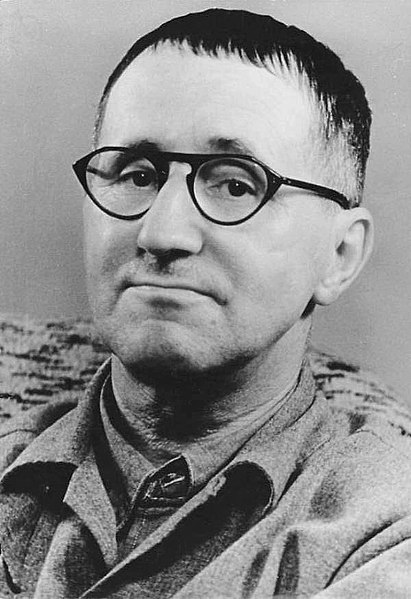
Brecht - His Background

File:Bertolt-Brecht.jpg
Bertolt Brecht (image from http://en.wikipedia.org/wiki/File:Bertolt-Brecht.jpg)
Bertolt Brecht was born in 1898 and died in 1956. He was a German political theatre writer and practitioner. He was brought up in a middle class household by a protestant mother and catholic father. He was 16 when World War 1 started. He found a way out of joining the army by taking an additional medical course at Munich University where he began his studies in 1917.


Brecht left Germany in 1933 when Hitler took power in fear of persecution.  He was a committed Marxist for his whole life something of course the Nazi regime was totally against. I have visited the Bavarian region and Munich city many times. It is important to remember that this is a separate state to the rest of Germany and has a very different set of rules, even today. Looking back to Brecht’s era it was in Munich, the capital of Bavaria where the Nazi party was born. This is also where most of the people who actually supported to regime lived and not just because they were under the duress of the Nazi party but because they truly believed in the facist ideology.  For the people living there with socialist left wing and anti-Nazi beliefs life would have been very difficult.  It is important to think about these things when thinking about Brecht as a political writer and why he developed the far left opinions he did. Growing up in Bavaria would have been and still is very right wing.

Brecht developed a style of theatre called ‘epic’ theatre. This is what we are exploring in our workshops. He used theatre and the poetry he wrote as a platform to express his political opinions and ideologies.  He wanted his audience to ask questions about what they were seeing. This is a concept we will be developing more through our work in class.

Tuesday, 6 November 2012

Lesson Notes Session 1


Moody Objects 

We created objects onstage with emotions linked to them such as shy or angry. This exercise could be used as a way of making an object onstage without using props. It incorporated Brecht's aim to make the audience question what they see in front of them. This is because it creates something strange and out of the ordinary for an audience member to look at. As people when we see unusual things or things we do not know or understand we automatically question them.

In this exercise we had to create objects such as a happy toilet or an angry motor bike. In a naturalistic play all objects would be inanimate. By adding an emotion or personality trait to it you are showing the audience that it is not real. This is a vital part of Brecht's theatre genre 'epic' theatre. The idea of this was to have the audience constantly aware that what they were seeing was a play and not to immerse themselves so much in the story and the characters and what was happening but why it was happening too.

While doing this exercise we had to move around the space and get into groups of different numbers each time to form a new object. This added element could help to develop our ability to create work fast and begin to form functioning working relationships with everyone in our group. I found this exercise to be a useful way of understanding how to create something strange onstage. It allowed me to begin to understand Brecht's aims with his style of theatre as opposed to just hearing what it was about. This exercise was challenging in that we didn't have much time to form the objects which made it hard to make them believable. However, when I reflect this was probably a good thing because Brecht didn't want to create believable things onstage he wanted to audience to be aware that they weren’t real. Another part of this which I found difficult was that we didn't as actors have an intention behind the emotion we were showing on the object. We could all improvise the feeling and push in a fake emotion however we couldn't do that in an actual performance. Brecht wanted the audience to think about why things were happening onstage and not why and they can't begin to question it if the actors and director don't know themselves. Of course this was not an issue in the small exercise we did today but I thought it was something I should develop as we progress with our political theatre work.


Daily Tasks

We all got into a space in the room. We had to choose an activity that we did every day. We had to go through it and mime it all out in detail. Then we did it again but we had to speak out everything we did in detail. Explaining every movement and every object, not why we were doing it but what we were doing.

When people spoke through their task it made it so the audience didn’t have to think about what was going on onstage or think about the character. When they mimed it you had to wonder about what they were doing and what objects they were using. The version where we mimed the exercise was closer to naturalism than to epic theatre. As it required to audience to use their mind to think about what was going on onstage not why. Whereas when they spoke through the task we could stop thinking about what they were doing and begin to think why and about how it was happening. This mean as an audience we were becoming more active thinkers as opposed to passively sitting and watching a story or situation unfold.  In a naturalistic play the actors wouldn’t be speaking through their every movement. By having an actor do this you are adding to this unrealistic effect that epic theatre is supposed to have.

The task I chose was putting on my make-up. I had to picture very clearly my bed and my mirror where I do my make-up every day. When I mimed the make-up I found it harder to memorize every single step I would do normally. I would forget to add in every detail. However, when I spoke out loud through everything I was doing I found it easier to be more precise with the movements.

An example of the work we watched was Stuart in our class talked and went through his process of making coffee in the morning, and how the hot water wasn’t on in his flat. He went through every step with extreme detail, right down to the particular type of milk he was using. This meant as an audience member I could picture easily what he was saying because everything he said he was seeing for himself and sharing that with us. This meant I could analyse his situation more. The reason Brecht wants us to do this is because he was a political practitioner and wanted us to question our society. If I incorporate this into when I watched Stuarts piece I could begin to question why he didn’t have hot water on and why he was living in a small flat with a small kitchen that he described, by didn’t he have one of those fancy coffee machines which does all the work for you. This can allow you to gain a deeper understanding or have a more interesting interpretation of the work as opposed to if you had to spend that whole time just trying to work out what was going on.